Showing posts with label Around the world. Show all posts

Nov 11, 2017

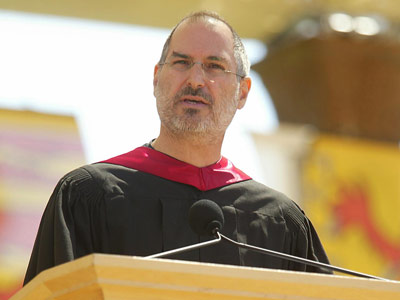
Steve Jobs’s speech - June 12, 2005 - Stanford University

Steve Jobs’s speech - June 12, 2005 - Stanford University
     “You’ve got to find what you love”
     This is a prepared text of the Commencement address delivered by Steve Jobs, CEO of Apple Computer and of Pixar Animation Studios, on June 12, 2005.

     I am honored to be with you today at your commencement from one of the finest universities in the world. I never graduated from college. Truth be told, this is the closest I’ve ever gotten to a college graduation. Today I want to tell you three stories from my life. That’s it. No big deal. Just three stories.
     The first story is about connecting the dots.
     I dropped out of Reed College after the first 6 months, but then stayed around as a drop-in for another 18 months or so before I really quit. So why did I drop out?
     It started before I was born. My biological mother was a young, unwed college graduate student, and she decided to put me up for adoption. She felt very strongly that I should be adopted by college graduates, so everything was all set for me to be adopted at birth by a lawyer and his wife. Except that when I popped out they decided at the last minute that they really wanted a girl. So my parents, who were on a waiting list, got a call in the middle of the night asking: “We have an unexpected baby boy; do you want him?” They said: “Of course.” My biological mother later found out that my mother had never graduated from college and that my father had never graduated from high school. She refused to sign the final adoption papers. She only relented a few months later when my parents promised that I would someday go to college.
     And 17 years later I did go to college. But I naively chose a college that was almost as expensive as Stanford, and all of my working-class parents’ savings were being spent on my college tuition. After six months, I couldn’t see the value in it. I had no idea what I wanted to do with my life and no idea how college was going to help me figure it out. And here I was spending all of the money my parents had saved their entire life. So I decided to drop out and trust that it would all work out OK. It was pretty scary at the time, but looking back it was one of the best decisions I ever made. The minute I dropped out I could stop taking the required classes that didn’t interest me, and begin dropping in on the ones that looked interesting.
     It wasn’t all romantic. I didn’t have a dorm room, so I slept on the floor in friends’ rooms, I returned Coke bottles for the 5¢ deposits to buy food with, and I would walk the 7 miles across town every Sunday night to get one good meal a week at the Hare Krishna temple. I loved it. And much of what I stumbled into by following my curiosity and intuition turned out to be priceless later on. Let me give you one example:
Steve Jobs’s speech - June 12, 2005 - Stanford University
     Reed College at that time offered perhaps the best calligraphy instruction in the country. Throughout the campus every poster, every label on every drawer, was beautifully hand calligraphed. Because I had dropped out and didn’t have to take the normal classes, I decided to take a calligraphy class to learn how to do this. I learned about serif and sans serif typefaces, about varying the amount of space between different letter combinations, about what makes great typography great. It was beautiful, historical, artistically subtle in a way that science can’t capture, and I found it fascinating.
     None of this had even a hope of any practical application in my life. But 10 years later, when we were designing the first Macintosh computer, it all came back to me. And we designed it all into the Mac. It was the first computer with beautiful typography. If I had never dropped in on that single course in college, the Mac would have never had multiple typefaces or proportionally spaced fonts. And since Windows just copied the Mac, it’s likely that no personal computer would have them. If I had never dropped out, I would have never dropped in on this calligraphy class, and personal computers might not have the wonderful typography that they do. Of course it was impossible to connect the dots looking forward when I was in college. But it was very, very clear looking backward 10 years later.
     Again, you can’t connect the dots looking forward; you can only connect them looking backward. So you have to trust that the dots will somehow connect in your future. You have to trust in something — your gut, destiny, life, karma, whatever. This approach has never let me down, and it has made all the difference in my life.
     My second story is about love and loss.
     I was lucky — I found what I loved to do early in life. Woz and I started Apple in my parents’ garage when I was 20. We worked hard, and in 10 years Apple had grown from just the two of us in a garage into a $2 billion company with over 4,000 employees. We had just released our finest creation — the Macintosh — a year earlier, and I had just turned 30. And then I got fired. How can you get fired from a company you started? Well, as Apple grew we hired someone who I thought was very talented to run the company with me, and for the first year or so things went well. But then our visions of the future began to diverge and eventually we had a falling out. When we did, our Board of Directors sided with him. So at 30 I was out. And very publicly out. What had been the focus of my entire adult life was gone, and it was devastating.
Steve Jobs’s speech - June 12, 2005 - Stanford University
     I really didn’t know what to do for a few months. I felt that I had let the previous generation of entrepreneurs down — that I had dropped the baton as it was being passed to me. I met with David Packard and Bob Noyce and tried to apologize for screwing up so badly. I was a very public failure, and I even thought about running away from the valley. But something slowly began to dawn on me — I still loved what I did. The turn of events at Apple had not changed that one bit. I had been rejected, but I was still in love. And so I decided to start over.
     I didn’t see it then, but it turned out that getting fired from Apple was the best thing that could have ever happened to me. The heaviness of being successful was replaced by the lightness of being a beginner again, less sure about everything. It freed me to enter one of the most creative periods of my life.
     During the next five years, I started a company named NeXT, another company named Pixar, and fell in love with an amazing woman who would become my wife. Pixar went on to create the world’s first computer animated feature film, Toy Story, and is now the most successful animation studio in the world. In a remarkable turn of events, Apple bought NeXT, I returned to Apple, and the technology we developed at NeXT is at the heart of Apple’s current renaissance. And Laurene and I have a wonderful family together.
     I’m pretty sure none of this would have happened if I hadn’t been fired from Apple. It was awful tasting medicine, but I guess the patient needed it. Sometimes life hits you in the head with a brick. Don’t lose faith. I’m convinced that the only thing that kept me going was that I loved what I did. You’ve got to find what you love. And that is as true for your work as it is for your lovers. Your work is going to fill a large part of your life, and the only way to be truly satisfied is to do what you believe is great work. And the only way to do great work is to love what you do. If you haven’t found it yet, keep looking. Don’t settle. As with all matters of the heart, you’ll know when you find it. And, like any great relationship, it just gets better and better as the years roll on. So keep looking until you find it. Don’t settle.
     My third story is about death.
     When I was 17, I read a quote that went something like: “If you live each day as if it was your last, someday you’ll most certainly be right.” It made an impression on me, and since then, for the past 33 years, I have looked in the mirror every morning and asked myself: “If today were the last day of my life, would I want to do what I am about to do today?” And whenever the answer has been “No” for too many days in a row, I know I need to change something.
     Remembering that I’ll be dead soon is the most important tool I’ve ever encountered to help me make the big choices in life. Because almost everything — all external expectations, all pride, all fear of embarrassment or failure — these things just fall away in the face of death, leaving only what is truly important. Remembering that you are going to die is the best way I know to avoid the trap of thinking you have something to lose. You are already naked. There is no reason not to follow your heart.
Steve Jobs’s speech - June 12, 2005 - Stanford University
     About a year ago I was diagnosed with cancer. I had a scan at 7:30 in the morning, and it clearly showed a tumor on my pancreas. I didn’t even know what a pancreas was. The doctors told me this was almost certainly a type of cancer that is incurable, and that I should expect to live no longer than three to six months. My doctor advised me to go home and get my affairs in order, which is doctor’s code for prepare to die. It means to try to tell your kids everything you thought you’d have the next 10 years to tell them in just a few months. It means to make sure everything is buttoned up so that it will be as easy as possible for your family. It means to say your goodbyes.
     I lived with that diagnosis all day. Later that evening I had a biopsy, where they stuck an endoscope down my throat, through my stomach and into my intestines, put a needle into my pancreas and got a few cells from the tumor. I was sedated, but my wife, who was there, told me that when they viewed the cells under a microscope the doctors started crying because it turned out to be a very rare form of pancreatic cancer that is curable with surgery. I had the surgery and I’m fine now.
     This was the closest I’ve been to facing death, and I hope it’s the closest I get for a few more decades. Having lived through it, I can now say this to you with a bit more certainty than when death was a useful but purely intellectual concept:
     No one wants to die. Even people who want to go to heaven don’t want to die to get there. And yet death is the destination we all share. No one has ever escaped it. And that is as it should be, because Death is very likely the single best invention of Life. It is Life’s change agent. It clears out the old to make way for the new. Right now the new is you, but someday not too long from now, you will gradually become the old and be cleared away. Sorry to be so dramatic, but it is quite true.
     Your time is limited, so don’t waste it living someone else’s life. Don’t be trapped by dogma — which is living with the results of other people’s thinking. Don’t let the noise of others’ opinions drown out your own inner voice. And most important, have the courage to follow your heart and intuition. They somehow already know what you truly want to become. Everything else is secondary.
When I was young, there was an amazing publication called The Whole Earth Catalog, which was one of the bibles of my generation. It was created by a fellow named Stewart Brand not far from here in Menlo Park, and he brought it to life with his poetic touch. This was in the late 1960s, before personal computers and desktop publishing, so it was all made with typewriters, scissors and Polaroid cameras. It was sort of like Google in paperback form, 35 years before Google came along: It was idealistic, and overflowing with neat tools and great notions.
     Stewart and his team put out several issues of The Whole Earth Catalog, and then when it had run its course, they put out a final issue. It was the mid-1970s, and I was your age. On the back cover of their final issue was a photograph of an early morning country road, the kind you might find yourself hitchhiking on if you were so adventurous. Beneath it were the words: “Stay Hungry. Stay Foolish.” It was their farewell message as they signed off. Stay Hungry. Stay Foolish. And I have always wished that for myself. And now, as you graduate to begin anew, I wish that for you.
     Stay Hungry. Stay Foolish.
     Thank you all very much.
     Steve Jobs


Jul 31, 2017

Insects and animals. The top new species of 2016

     Humans have made their way to the moon, landed rovers on Mars and sent spacecraft to the outer reaches of the solar system. But the Earth remains a little-known planet. That becomes clear when naturalists look for creatures closer to home and find unknown gems. Here are our favorite new species of 2016.
     UNKNOWN TUMBLER
     Tumbleweeds are synonymous with the American West. At some point, two of them interbred to form a new species, Salsola ryanii, which is about 5 feet in height and nearly as wide. Usually, such hybrids are sterile, but in this case, the plant underwent an unusual genetic event that led to a duplication of its entire genome. That allowed it to reproduce and also made it incompatible with either of its parents. It has been found at 15 sites throughout California. "It's extremely rare to catch a new species in the act of appearing and expanding," says Norm Ellstrand, a professor of genetics at the University of California, Riverside, "and very exciting."
Illacme Tobini     HOW MANY PENISES?
     When biologist Jean Krejca unearthed an extremely leggy millipede in a remote cave in California's Sequoia National Park, she knew it was special, so she sent it to the millipede experts Bill Shear and Paul Marek. They determined it was a new species and gave it the name Illacme Tobini. With 414 legs, it's one of Earth's leggiest creatures. It is closely related to Illacme plenipes, which lives about 150 miles away and has 750 legs—the most of any animal. The millipede also has four gonopods, the millipede equivalents of penises, and boasts zoo poison glands.

     A VEGETARIAN PIRANHA
Myloplus Zorror

     Piranhas are famous for their fearsome teeth and ability to quickly devour flesh. But not all creatures in this biological family are so brashly carnivorous. Researchers from Brazil's Federal University of Para have discovered a new species of piranha-like fish with chompers specialized for grinding seeds and other vegetable debris that falls into the tributaries of the western Amazon, where it lives. It grows to a length of i8 inches and has reddish coloration, with yellow on its fins and belly, and it is sought after by fishermen for its meat. The biologists named it Myloplus Zorroi, after the fictional character Zorro, a hero in Latin America.

Whip Scorpions
     WHIP SCORPIONS
     Whip spiders, also known as tailless Whip Scorpions, display more variety than scientists knew. Brazilian researchers uncovered eight new species of these animals in the Amazon rain forest of northern Brazil. They aren't true spiders—they lack silk and venom glands—but they do possess fearsome-looking appendages called pedipalps that look like arms with claws and are used to grab prey. These spiny freaks hang out in caves or leaf litter. To tell the species apart, researchers Gustavo Miranda and Alessandro Giupponi counted the hairs on their pedipalps.

     THE LEAF THAT WASN'T
Poltys

     When is a leaf not a leaf? When it's a spider. Max Kuntner, an arachnologist at the Research Center of the Slovenian Academy of Science and Arts, and colleagues discovered the creature on a night-time walk through a rain forest in southern China. They placed it in the genus Poltys with orb-weaving spiders that live in China and produce distinctive circular webs. It's the first arachnid known to mimic foliage, a survival strategy that helps it avoid predation by wasps and other insects.

Chilabothrus Argentumr
     SNAKE IN THE SUN
     The Bahamas are hardly an unexplored place. It came as quite a shock, then, to herpetologist Graham Reynolds when he found a handsome, undescribed silver serpent on a small uninhabited Bahaman island. Reynolds, who works at the University of North Carolina-Asheville, called it the Conception Bank silver boa (Chilabothrus Argentum), and it's already listed as critically endangered: Reynolds and his colleagues found only 33 of them on the island.

     GLOWFISH
Monacoa Griseus

     These fish don't need a light—they carry their own, thanks. In August, scientists reported that they had found two new species of deep sea fish with this unusual arrangement. They have light-producing bacteria in a pouch within their gut that makes them appear to glow. They can change the size of this pouch, contracting it to hide the light and expanding it to reveal the light, which then passes through transparent scales on their underside. The scientists dubbed these new species the gray mirrorbelly and black mirrorbelly—Monacoa Griseus and Monacoa niger.
     PARASITE IN PURPLE
     While most plants rely on the sun for energy and food, some pursue an alternative stratagem: thievery. Japanese scientists have found a bizarre new plant they call Sciaphila yakushimensis (after Yakushima, the lush Japanese island where it was found). This species, like its relatives, makes its way aboveground only when it flowers—in this case with a purple blossom. It gets its sustenance by stealing nutrients from the roots and root-bound fungi of other plants.
     JOHNNY'S FAVORITE CRAWLER
     How many kinds of tarantulas exist in the United States? Until evolutionary biologist Chris Hamilton investigated, nobody knew. He and his colleagues spent nearly a decade looking for tarantulas and sorting through contradictory past studies. The team turned up 14 new tarantula species, mostly in the Southwest. An all-black species found near California's Folsom Prison—where Johnny Cash, the Man in Black, recorded a live album—was dubbed Aphonopelma johnnycashi.
Peacock Spider
     TEENY-TINY PEACOCKS
     Australian biologist Jurgen Otto has spent the past decade cataloguing Peacock Spiders, the males of which engage in adorably strange jigs to woo females, extending their furry legs and flashy abdomens. He's discovered dozens of new varieties, and in May, he co-authored a paper in the journal Peckhamia identifying seven more. The spiders range in length from 0.1 to 0.2 inches, and they are often brightly and brilliantly colored. 

     Source: Newsweek, 6.01.2017 – 13.01.2017, by Douglas Main, pp. 52–53.  

Jul 28, 2017

Old MacDonald had a farm

Old macdonald had a farm
     “Old MacDonald Had a Farm” is a children’s song and nursery rhyme about a farmer named MacDonald (or McDonald, Macdonald) and the various animals he keeps on his farm. Each verse of the song changes the name of the animal and its respective noise. In many versions, the song is cumulative, with the animal sounds from all the earlier verses added to each subsequent verse. It has a Roud Folk Song Index number of 745. For example, the verse uses a cow as an animal and “moo” as the animal’s sound.
     It has been translated in many languages.

Old MacDonald had a farm
E-I-E-I-O
And on his farm he had a cow
E-I-E-I-O
With a moo-moo here
And a moo-moo there
Here a moo, there a moo
Everywhere a moo-moo
Old MacDonald had a farm 
E-I-E-I-O
Old macdonald had a farm

Jul 16, 2017

1830 Abraham Lincoln: letter to his son’s teacher

Abraham Lincoln Memorial statue
He will have to learn, I know, that all men are not just, all men are not true, but teach him also that for every scoundrel there is a hero; that for every selfish politician, there is a dedicated leader.
Teach him that for every enemy there is a friend.
It will take time, I know, but teach him, if you can, that a dollar earned is of far more value than five found… Teach him to learn to lose… and also to enjoy winning.
Steer him away from envy, if you can, teach him the secret of quiet laughter.
Let him learn early that the bullies are the easiest to lick…
Teach him, if you can, the wonder of a book… But also give him quiet time to ponder the eternal mystery of birds in the sky, bees in the sun, and flowers on a green hillside.
In school, teach him it is far more honorable to fail than to cheat…
Mount Rushmore Abraham Lincoln
Teach him to have faith in his own ideas, even if everyone tells him they are wrong…
Teach him to be gentle with gentle people, and tough with the tough. 
Try to give my son the strength not to follow the crowd when everyone is getting on the bandwagon…
Teach him to listen to all men… but teach him also to filter all he hears on a screen of truth, and take only the good that comes through.
Teach him, if you can, how to laugh when he is sad…
Teach him there is no shame in tears.
Teach him to scoff at cynics and to beware of too much sweetness…
Teach him to sell his brawn and brain to the highest bidders, but never to put a price tag on his heart and soul.
one cent coin Abraham Lincoln
Teach him to close his ears to a howling mob… and to stand and fight if he thinks he is right.
Treat him gently, but do not coddle him, because only the test of fire makes fine steel. 
Let him have the courage to be impatient… let him have the patience to be brave. 
Teach him always to have sublime faith in himself, because then he will always have sublime faith in mankind.
This is a big order, but see what you can do…
He is such a fine little fellow, my son! 

     Abraham Lincoln (1809-1865) was the sixteenth president of the United States. He abolished slavery. He was recalled in many ways. Some American cities bear his name, as the Lincoln the capital of Nebraska. USA dedicated to him the Lincoln Memorial in Washington, and is depicted on the five dollar bill and the one cent coin. His face was carved in the monument of Mount Rushmore (the first right).
Abraham Lincoln Five Dollar Bill

Jun 20, 2017

The age of technology

The age in which we live is an age of extraordinary scientific and technological progress. It is the age of space flights, of television, of nuclear power, of clever chemistry, of automation and computers, of the transplant of living organs, of sensational discoveries in biology and medicine.
It is an age of wonders.
The trouble is that too many benign conquests also have their negative sides. Inventions and discoveries that open up new worlds of peace and power also open up new worlds of war and destruction. The creation of new terrible arms, the tragedy of pollution, which is gradually destroying so many forms of life on our planet, are but a few examples of man’s offenses against the world we live in. 
Source: Colle – Meloni, News. For Juniors, Lattes, an old Italian book 1979. 
technology

Jun 4, 2017

For he's a jolly good fellow

American version
For he's a jolly good fellow, for he's a jolly good fellow
For he's a jolly good fellow (pause), which nobody can deny
Which nobody can deny, which nobody can deny
For he's a jolly good fellow, for he's a jolly good fellow
For he's a jolly good fellow (pause), which nobody can deny!

For he's a jolly good fellow
     It’s a popular song widespread in many countries.
     According to the Guinness World Records, is the second-most popular song in the English language, following "Happy Birthday to You" and followed by "Auld Lang Syne".
     The melody originates from the French song "Marlbrough s'en va-t-en guerre" ("Marlborough Has Left for the War"). It was composed the night after the Battle of Malplaquet in 1709, during the War of Spanish Succession. The battle was a Pyrrhic victory for the Austrians under the British General John Churchill, Duke of Marlborough, and the French began to laugh at this song. The British then composed of new words to exalt him and in fact the "good guy" (the "jolly good fellow") was originally the Duke. The air origins date back, according to Chateaubriand, an Arab song of the times of the Crusades.
     It became a French folk tune and was popularized by Marie Antoinette after she heard one of her maids singing it. 
For he's a jolly good fellow
     The melody became so popular in France that it was used to represent the French defeat in Beethoven's composition "Wellington's Victory" Opus 91 written in 1813.
     The melody also became widely popular in the United Kingdom. By the mid-19th century it was being sung with the words "For he's a jolly good fellow", often at all-male social gatherings. By 1862, it was already familiar in America.
For he's a jolly good fellow


     Today "For He's a Jolly Good Fellow" is a popular song that is sung to congratulate a person on a significant event, such as a promotion, a birthday, a wedding (or playing a major part in a wedding), a wedding anniversary, the birth of a child, or the winning of a championship sporting event. The traditional children's song The Bear Went Over the Mountain is sung to the same tune.

British version
For he's a jolly good fellow, for he's a jolly good fellow
For he's a jolly good fellow (pause), and so say all of us
And so say all of us, and so say all of us
For he's a jolly good fellow, for he's a jolly good fellow 
For he's a jolly good fellow (pause), and so say all of us!

May 22, 2017

The making of Australia

Australia. History
     The settlement of Australia by the Aborigines is at least 25,000 – 40,000 years old. They immigrated from South East Asia and there were about 300,000 of them when Europeans arrived.
     The Dutch came in 1616, and in 1644 Australia was called New Holland. The British first arrived in 1688. It Was in 1770 that James Cook, a British explorer, took scientists to study the plants, animals and native people, in his first ship, the Endeavour. He wanted to claim the land for Britain and, in April 1770, he charted the east coast of Australia, and named it New South Wales. There was a scientist on the ship, Joseph Banks who was so fascinated by the range of plants in a bay, that the British named it Botany Bay.
     Sailing north, the ship was damaged when it ran into coral on the Great Barrier Reef. After repairing the ship they sailed back to Britain, arriving in July 1771. In London, Joseph Banks suggested that Botany Bay would be a very good place to start a colony.
James Cook Australia Trip
     In 1788 the first feet of eleven ships from Britain landed in Botany Bay to establish the colony of New South Wales. There were about 1,050 people, mostly prisoners from British prisons sent to begin a colony. They moved from Botany Bay to Sydney Cove where there was fresh water and better soil. The settlers called the place The Rocks. Later free settlers began to arrive from Britain wanting to start a new life. Most immigrants to Australia for the next 150 years were of British origin. 
Source: Excursion, an old Italian book. 
Captain James Cook portraitJames Cook Australia

Apr 24, 2017

The English at Home

The English don’t like to live in busy city streets. They dislike blocks of flats which are all alike and have no individuality. They prefer to buy or to rent a small house on the outskirts, away from the noise and the traffic of the town centre.
United Kingdom
The typical suburban house is a two-storey building with six rooms and two gardens: a front garden full of flowers and a back garden with fruit-trees and vegetables.
Instead of a number each house has a pretty name which distinguishes it from the house next door: “May Flowers”, “Red Roses”, “The Cottage”, and the like.
The first thing an Englishman does with his house is to surround it with a fence or a hedge in order “to shut out the neighbours” and to preserve his privacy and freedom. Freedom, in fact, for an Englishman means above all the right to live his private life, a private life into which he refuses to admit any but his closest friends.
Behind the closed door of his “castle” the Englishman enjoys being alone with his family, looking after his pets, reading his favourite newspaper, smoking his pipe, or spending a quiet evening sitting in front of the television set.
In summer, when the weather is nice and sunny, he likes to spend his spare time in the garden, watering the flowers, cutting the hedge or mowing the lawn. He loves flowers, and gardening is one of his favourite hobbies.
Sometimes he has tea in the garden with his wife, while his children play on the grass with their pets. Pets live in the house and are considered members of the family. English people are very fond of animals, and you can hardly find any English family who does not have a dog, a goldfish, a bird or even a pony as a pet. 
Source: R. Colle – I. Vay, L’esame di inglese, Lattes, an old Italian book 1974. 

Apr 4, 2017

“Will Hunting” Monologue, Robin Williams

will hunting
Sean and Will sit in the bleachers at the mostly empty park. They look out over a small pond, in which a group of schoolchildren on a field trip ride the famous Swan Boats.
WILL: So what's with this place? You have a swan fetish? Is this something you'd like to talk about?
SEAN: I was thinking about what you said to me the other day, about my painting. I stayed up half the night thinking about it and then something occurred to me and I fell into a deep peaceful sleep and haven't thought about you since. You know what occurred to me?
WILL: No.
SEAN: You're just a boy. You don't have the faintest idea what you're talking about.
WILL: Why thank you.
SEAN: You've never been out of Boston.
WILL: No.
SEAN: So if I asked you about art you could give me the skinny on every art book ever written...Michelangelo? You know a lot about him I bet. Life's work, criticisms, political aspirations. But you couldn't tell me what it smells like in the Sistine Chapel. You've never stood there and looked up at that beautiful ceiling. And if I asked you about women I'm sure you could give me a syllabus of your personal favorites, and maybe you've been laid a few times too. But you couldn't tell me how it feels to wake up next to a woman and be truly happy. If I asked you about war you could refer me to a bevy of fictional and non-fictional material, but you've never been in  one. You've never held your best friend's head in your lap and watched him draw his last breath, looking to you for help. And if I asked you about love I'd get a sonnet, but you've never looked at a woman and been truly vulnerable. Known that someone could kill you with a look. That someone could rescue you from grief. That God had put an angel on Earth just for you. And you wouldn't know how it felt to be her angel. To have the love be there for her forever. Through anything, through cancer. You wouldn't know about sleeping sitting up in a hospital room for two months holding her hand and not leaving because the doctors could see in your eyes that the term "visiting hours" didn't apply to you. And you wouldn't know about real loss, because that only occurs when you lose something you love more than yourself, and you've never dared to love anything that much. I look at you and I don't see an intelligent confident man, I don't see a peer, and I don't see my equal. I see a boy. Nobody could possibly understand you, right Will? Yet you presume to know so much about me because of a painting you saw. You must know everything about me. You're an orphan, right?
Will nods quietly.
SEAN: (cont'd) Do you think I would presume to know the first thing about who you are because I read "Oliver Twist?" And I don't buy the argument that you don't want to be here, because I think you like all the attention you're getting. Personally, I don't care. There's nothing you can tell me that I can't read somewhere else. Unless we talk about your life. But you won't do that. Maybe you're afraid of what you might say.
Sean stands,
SEAN: (cont'd) It's up to you. 
And walks away.

Mar 30, 2017

S.O.S. Save Our Souls

It was a stormy night on the Atlantic Ocean.
The liner Carmania which was crossing the Atlantic bound for Europe, picked an S.O.S. signal coming from the ship Volturno. This liner was asking for help as she was on fire.
Sos
In spite of the storm, the Carmania proceeded at her maximum speed towards the ship on fire.
But she was not the only liner to go to the rescue.
At dawn ten vessels could be seen around the Volturno.
Something terrible had happened on board the burning ship: some passengers had thrown themselves into the sea to escape the fire and had been drowned; others had tried to save themselves in the life-boats, but most of these had capsized. The ships around could do nothing because of the rage of the storm. 
All the passengers would have died if a tanker hadn’t arrived. She poured her oil on the water and so the waves abated. All at once the ten liners lowered their life-boats and so all those who had remained on hoard the Volturno were saved. 

Mar 20, 2017

“The Devil’s advocate” Monologue, Al Pacino

Devil
I want you to be yourself. You know, boy, guilt is like a bag of fucking bricks. All you gotta do is set it down… Who are you carrying all those bricks for anyway? God? Is that it? God? Well, I’ll tell ya, lemme give you a little inside information about God. God likes to watch. He’s a prankster. Think about it. He gives man instincts! He gives this extraordinary gift and then what does he do? I swear for his own amusement his own private cosmic gag reel – he sets the rules in opposition. It’s the goof of all time! Look. But don’t touch! Touch. But don’t taste! Taste. Don’t swallow! And while you’re jumping from one foot to the next, he’s laughing his sick fucking ass off! He’s a tight ass, he’s a sadist, he’s an absentee landlord! Worship that never!
Kevin
Better to reign in Hell than serve in Heaven, is that it?
Devil
Why not? I’m here on the ground with my nose in it since the whole thing began! I’ve nurtured every sensation Man has been inspired to have! I cared about what he wanted and I never judged him. Why? Because I never rejected him. In spite of all his imperfections, I’m a fan of man! 
I’m a humanist. Maybe the last humanist. Who, in their right mind, Kevin, could possibly deny the 20th century was entirely mine? All of it, Kevin, all of it! Mine! I’m peaking here! It’s my time now. It’s our time. 
The devil's advocate

Mar 16, 2017

The English at Table

english breakfast
English women don’t devote so much time to cooking as women on the Continent do, and they often use tinned food. Still they are very fond of making cakes, puddings and innumerable cups of tea.
Early in the morning, while they are still in bed, the English like to have their first cup of tea with a biscuit. Later on they have breakfast, which is a more substantial meal than on the Continent. Some people eat porridge or corn-flakes with hot or cold milk to begin with. Then the main course is served. It generally consists of eggs and bacon, sausages with tomatoes, and a few slices of toast and butter. Coffee and tea are the most popular drinks at breakfast.
Lunch is usually a lighter meal in England than on the Continent. Many children have their midday meal at school, and most working people, having no time to go back home for lunch, have just a snack at a self-service restaurant or a coffee bar. Fish and chips, cheese, salads, omelettes are among the most typical dishes.
The English drink no wine during their meals because wine in England isn’t as cheap as it’s in Italy. They generally have milk, lemonade, fruit-juice or beer instead.
At about five o’clock, most people have afternoon tea. The English are great tea-drinkers: they have tea at any time of the day: early in the morning, at breakfast, after lunch, in the afternoon, after supper and again before going to bed. They generally drink tea with milk and not with lemon as we do in Italy. Since they are very fond of sweet things they always have cakes and biscuits with their tea.
Dinner is the biggest meal of the day. It generally consists of three main courses: soup, meat or fish with vegetables, and dessert.
The English don’t eat as much bread during their meals as we do. They have sliced bread instead of rolls and usually spread butter on it. 
Source: R. Colle – I. Vay, L’esame di inglese, Lattes, an old Italian book 1974. 

Feb 6, 2017

Grandparents: support network or parental substitute?

Is wonder in observing the changes that have involved our society in last years. The stability objectives have become utopian velleity. Still remember your childhood? As children, the days were marked by play and study with the supervision of our parents. On Sundays or holidays we went by our grandparents, the darlings of the children, with silver hair and the spirit of a little child. Not often we could see them, but we adored them. It’s essential to weave a loving relationship with the parents of our parents. Then, they were retired, uncertain element for the new generations, and had time and serenity to spend with grandchildren.
Grandparents and grandchildren Silvana Calabrese
Following the social mechanism is changed, the past has become a nuanced memory as a dream vision that fades away slowly. Inebriated by the idea that progress was the key to achieve a living standards equal or higher than that of our parents; deluded by the expectation that the world itself has triggered in all of us, we obeyed to the system with the secret hope to realize the unrealized dreams. We enrolled at the university, rather, we have invested in the education achieving medium–high levels. The immediate consequence concerned the personal ambitions of success that result by the active and stable insertion in the working world. The desire to make a career emerged almost immediately. Women’s employment has been more suffered the effects of social frictions, however were recorded vital signs. But this has caused further problems related to conciliation of roles assumed by the woman worker, housewife, wife and mother. Sometimes the challenges are unisex and look after the children, no longer conceived at a young age, it’s a serious challenge. In this emergency situation intervene the network of family support for excellence: the support provided by grandparents. Similar to the handyman they provide a free service, wide–ranging and flexible with the undisputed advantage of the trust relationship. They are available to look after their grandchildren, allowing to the married couple to overcome the assumption of a baby–sitter and save money for their children’s future. By the observation of the current reality I perceive a feeble alarm: grandparents are omnipresent in their grandchildren’s life to the point that they no longer constitutes a mere support, but a parental surrogate, the free from educational tool that only a father and a mother may be using. There’s a subversion from the past, now children spent Sunday with their parents, who are losing the best years of their children. 
Source: “La Gazzetta del Mezzogiorno”, an italian newspaper, October 14, 2013, p. 16. 

Jan 29, 2017

Prayers. Our Father and Hail Mary

Sometimes we have to pray. Sometimes we need to do that.
For faith or need here are the principals prayers.

our father
OUR FATHER
Our Father, who art in heaven,
hallowed be thy Name.
thy kingdom come,
thy will be done,
on earth as it is in heaven.
Give us this day our daily bread,
and forgive us our trespasses
as we forgive those who trespass against us
and lead us not into temptation,
but deliver us from evil.
Amen.


Hail Mary 1

HAIL MARY
Hail Mary, full of grace,
the Lord is with thee.
Blessed art thou among women,
and blessed is the fruit of thy womb, Jesus.
Holy Mary, Mother of God,
pray for us sinners,
now and at the hour of our death. 
Amen


Hail Mary full of graceprayer


Jan 27, 2017

Italy excelled in the horror of the Holocaust

Our South (of Italy), the same one that is lagging behind the rest of the nation, during the Second World War took the leading position in the horror of Holocaust hosting a concentration camp. On Memorial Day, remino that. 
Italy excelled in the horror of the Holocaust Memorial day Silvana Calabrese
By reconstruction of the Calabrian doctor Spartacus Capogreco, in June of ’40 by order of the Ministry of the Interior was built a concentration camp in Ferramento di Tarsi, Cosenza. Here until the arrival of the Allies on 8-9-’43 two thousand people were interned. On 27-1-’45 the Auschwitz camp was liberated by Soviet troops. In Remembrance Day we remember the Holocaust, the Shoah, the catastrophe, the genocide of 6 million Jews, but also homosexuals, prostitutes, Gypsies, and any other person inferios than the Aryan race. The horror of the concentration camps (or extermination camps) was known only at the end of the war. We have visually knowledge of that, through the testimony of the few survivors of atrocities, but also through the “Nuremberg Trials that indicates two sets of trials of Nazis involved in WWII and the Holocaust. Were held in the German city from 20-11-’45 to 1-10-’46 in the Palace of Justice. The first was the Trial of the Major War Criminals before the International Military Tribunal. The second was for war criminals, including the process and lower the Doctors” (I quote the book Theatrum mundi. Landing on the Moon, p. 99 note 6).
The victims were crossing the gate of Auschwitz surmounted by the inscription “Arbeit macht frei”, in German “Work makes you free”, but only death would set them free because there were several waiting for atrocities. The prisoners of the concentration camps were deprived of their identity, replaced by a number, and their dignity, an inalienable right. In addition to hard labor, common destiny were shooting and extermination in gas chambers, disguised as showers from which flowed the gas Zyklon B or prussic acid or cyanide, highly toxic and volatile liquid that is obtained by combining cyanide and sulfuric acid is highly corrosive. The deportees were also subjected to medical experiments that included the inoculation of infectious and deadly virus in order to experience the effects of germ warfare. Not to mention the crematorium useful to dispose of the amount of corpses reduced to a pile of bones. On January 27, we reflect on these shameful pages of history.

Source: “La Gazzetta del Mezzogiorno”, an italian newspaper, January 27, 2013, p. 16.

Jan 22, 2017

About Australia

Geography
Australian Flag
     Australia is a huge landmass on the other side of the world fro Europe. A jumbo jet takes about 21 hours to get there! It is in the southern hemisphere between the Indian and Pacific Oceans, about 11,250 miles away. Being the only large piece of land in the continent of Australasia it is sometimes considered a continent itself. Together with the State of Tasmania, it is the world's smallest continent.
It is almost as big as the USA, and is about 25 times bigger than Britain and Ireland. It is also  flattest, the driest and the lowest of all continents – its average height above sea level is only 300 metres, while the average height for the rest of the world is 700 metres.
     It is a land of great contrasts. Its climate ranges from hot and tropical in the north, to cool and wet in the south. The inland region is called the outback, a huge dry area where cattle and sheep graze, and wild animals such as kangaroos and emus live. 
Australia
     Very few people live there and life is very isolated. Some of the farms are larger than a small European country, and are several hours drive from the nearest town. In North Queensland some small parts are so wet that rain forests grow. In the south-east of the country, there is an area of alpine country with snow-covered mountains in winter.
Curiosities
Australia is a great wine country and exports all over the world. South Australia is the centre for high quality reds.
Stretching for 2,000 km along the North Queensland coast is the Great Barrier Reef, the largest coral reef in the world.
A popular attraction in the Central Desert is Ayers Rock, the world’s largest rock. It is a single stone with a circumference of 8 kilometres, famous for its beautiful colour changes from sunrise to sunset.
Politics
Australia is a parliamentary democracy, and it is also a federation of six states that form the Commonwealth of Australia. It has a Federal Government plus six separate State Governments. Queen Elizabeth II is also the Queen of Australia and is represented by a Governor-General and by a Governor in each state. Many Australians, however, like their country to become a republic.
Facts about Australia
Language: the official language is English, spoken with a distinctive Australian accent.
Australia presentation
Money: 1the official money is the Australian dollar. 1 dollar = 100 cents.
Size: 7,682,300 sq. km.
Some things Australia is famous for: surfing, beer, sheep, dreamtime, eucalyptus, barbecues, didgeridoos, kangaroos, Aborigine art, wine, coral, koalas, boomerangs, Christmas in the summer.
Capital city: Canberra, the only major city not on the coast.
Major cities: Sydney, Melbourne, Adelaide, Perth, Brisbane,
Population: About twenty-three million people. Despite its very low population density, two people per square km, Australia is one of the world’s most urbanized countries. Over 85 per cent of the population live in big cities along the coast in the temperate parts of the country. The five largest cities contain 60 per cent of the population. Some people live in rote areas and they do not even have a telephone, communicating with the rest of the world by radio.
Wildlife: Australian plants, animals and birds are unique because the continent has been isolated for so long. Among them is the koala (one of the symbols of the country), the kookaburra, (very large bird with a noisy call), the platypus and the kangaroo, another Australian symbol.
The first Australians: Aborigines were the first inhabitants of Australia and came from the north by boat between 25,000 and 40,000 years ago. For many years they had little contact with other cultures. A few thousand still live traditionally by hunting and living together in tribes. Many have moved to cities, and although are professionals, many are poor and isolated from their own, and white society.

     Source: Excursion, an old Italian book.